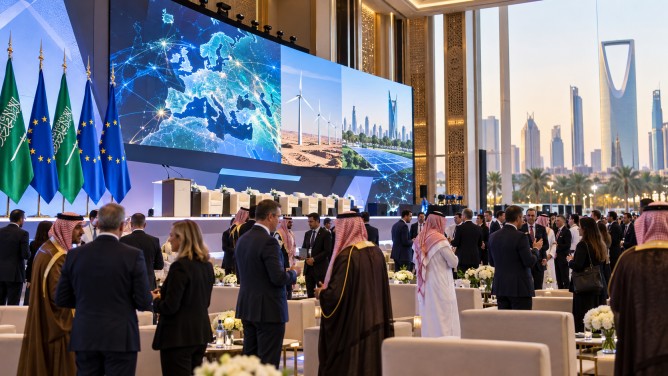
The EU-Gulf Cooperation Council (GCC) Summit in Riyadh, scheduled for October 24, is set to emphasize investment in artificial intelligence (AI), digital infrastructure, clean energy, and advanced industries. This focus signals a shift towards a broader economic partnership beyond traditional trade between the European Union and GCC states.
Trade in goods between these regions reached €165.7 billion in 2025, yet both sides are increasingly interested in long-term joint projects and investments. AI is emerging as a key area of potential collaboration, with discussions likely to cover investments in data centers, cloud computing, high-performance computing, AI applications, and cybersecurity. The Gulf’s investment capacity combined with Europe’s research and technology expertise could foster new partnerships within the expanding AI economy.
Additionally, digital connectivity is garnering attention, with potential cooperation extending to telecommunications networks, data centers, cloud services, and cybersecurity. Clean energy remains a priority, with potential projects in solar and wind power, green hydrogen, energy storage, smart grids, and emissions-reduction technologies. These areas align with European demand for large-scale energy investments, presenting opportunities for Gulf investors and European technology companies to collaborate on projects within their markets and beyond.
The partnership could also grow into sectors like advanced manufacturing, logistics, financial technology, healthcare technology, and industrial equipment, potentially creating integrated value chains involving production, financing, development, and distribution by companies from both regions.
A significant economic issue remains the EU-GCC free trade agreement, which the European Union is pursuing to improve market access and establish clearer trade and investment rules. A consultation with businesses, investors, and chambers of commerce is part of the ongoing assessment of the agreement’s potential economic impact.
For Saudi Arabia, this partnership aligns with Vision 2030 goals, focusing on economic diversification, attracting investment and technology, and developing non-oil industries. Additionally, both Saudi Arabia and the EU support the India-Middle East-Europe Economic Corridor, which could enhance cooperation in transport, energy, and digital infrastructure.
An accompanying business forum will provide a venue for companies and investors to discuss potential projects in AI, data centers, clean energy, logistics, advanced industries, and financing. Although the summit is expected to identify areas for future cooperation, specific joint projects in AI or technology have not yet been formally announced, with discussions focusing on transforming broader economic priorities into tangible partnerships and investment opportunities.